quarta-feira, 24 de julho de 2013

Death is Nothing

I have just moved to the neighboring room.
I am who I am ... you are whom you are,
That which we were to one another,
We will always be.
Call me by my name.
Speak to me like you've always did.
Don't use a different tone ...
Don't take that look; solemn or sad.
Continue to laugh at that which made us laugh together.
Pray, smile, think of me, pray for me.
Let my name be pronounced at home,
As it always was,
Without pomposity or gloom.
Life is still the same,
It is what it always was
The string has not been cut.
Why should I be away from your thoughts?
Just because I am away from your sight?
I am not far, just on the other side of the road..
You see, every thing is fine ...
Wipe your tears and cry no more.

If you love me ...

A morte não é nada.
Eu somente passei
para o outro lado do Caminho.

Eu sou eu, vocês são vocês.
O que eu era para vocês,
eu continuarei sendo.

Me dêem o nome
que vocês sempre me deram,
falem comigo
como vocês sempre fizeram.

Vocês continuam vivendo
no mundo das criaturas,
eu estou vivendo
no mundo do Criador.

Não utilizem um tom solene
ou triste, continuem a rir
daquilo que nos fazia rir juntos.

Rezem, sorriam, pensem em mim.
Rezem por mim.

Que meu nome seja pronunciado
como sempre foi,
sem ênfase de nenhum tipo.
Sem nenhum traço de sombra
ou tristeza.

A vida significa tudo
o que ela sempre significou,
o fio não foi cortado.
Porque eu estaria fora
de seus pensamentos,
agora que estou apenas fora
de suas vistas?

Eu não estou longe,
apenas estou
do outro lado do Caminho...

Você que aí ficou, siga em frente,
a vida continua, linda e bela
como sempre foi.


by St. Augustine

sábado, 6 de julho de 2013

Strange ways of Love....


How many times have we got confused about love or no-love? How many times have we got confused by the confusing signals being sent across by the other person? Isn't it quite strange that we take so much time to figure out a simple relationship! ( Or is it actually a pretty complicated relationship? ). So that's pretty strange, isn't it? That we may be in love, but may not be knowing that we are. And we may NOT be in love but may be thinking that we actually are!! :)


They say, "Don't fall in Love. Rise in Love!". So that's where I start wondering..... Does 'Love' brings prosperity and happiness, or does it spell doom for the person? Standard philosophical response would be of course that something as pure and pious as 'Love', can do no harm. But then do we not notice numerous of lives getting spoiled by this same "Love"? Doesn't it waste hell lot of time of those love-struck couples? Or is it like that every relationship demands time? And of course, in many cases we even notice people committing suicides!! So is it 'Love' which is playing devil here, or is it that people themselves are devilish!! Strange ways...... :)

Not having a wild side can be quite a bit of disadvantage for guys. There are umpteen articles lying around which concludes that girls find themselves attracted to bad guys. And this is not a matter of articles alone, this could be easily experienced by us. Haven't we noticed the most beautiful girls of our class taken away by the most notorious, mischievous boy? And it has logic too.
So point is, the nice guys-those with nothing wild and unconventional to show off- are put off on back foot. They are most of the times, on a disadvantageous ground. Even though they might have much better qualities than the other set of guys, they always fail to get a nice girl. Why? Because the nice girls are always lured to the bad boys!! That's really strange, isn't it? But then, that's the way things mostly happen around :) 

Is love all the same in every cases, or is it different in different type of relationships? It is always so puzzling. The love of a mother for her child, the love of two friends, the love of love-struck couples.... are they all the same, or they are completely different? The obvious response seems to be that they are distinctly different, but wait! Some people also opin that love has the same basic threads everywhere. After all, don't you expect a clear commonality between all of them? Care, affection, empathy..... the most basic but important ingredients of Love, don't they bring a clear, distinctive, quite an intrinsic kind of similarity?? So much that we can say that "Its all the same in all cases"? Confusing, isn't it? :)


Random Thoughts

sexta-feira, 28 de junho de 2013

Maktub


MAKTUB Significa: Já estava escrito, ou escrito nas estrelas, em árabe.

Nada em nossa vida e existência são meras ou simplesmente coincidências. Tudo tem um fundamento por trás de cada acontecimento, do mais simples ao mais complexo. Quando desejamos algo puro, do fundo de nossas almas, o universo estaria lá, conspirando e atraindo tudo para que o nosso sucesso fosse inevitável. Acredito que tudo está escrito e que apesar do livre arbítrio, sempre chegamos ao encontro do que nos foi destinado...

O universo sempre conspira a nosso favor e muitas vezes nós mesmos conspiramos contra nós mesmos e não nos damos conta disso. Cabe a nós mesmos tornar o caminho mais rápido ou mais trabalhoso para nossa alma, decidindo se queremos ou não buscar o conhecimento necessário para o desenvolvimento de nosso espírito.

Sim, todos nós criamos a nossa realidade.Isso cabe não ao nosso eu egoísta, ou ego, mais sim a nossa verdadeira expressão da alma. Essa verdadeira expressão nada mais é do que as experiências que tomamos posse emocionalmente.E ai se encontra o grande paradoxo da existência.Se continuarmos a experimentar a mesma emoção e nunca a aposentarmos, tornado-a sabedoria, não evoluiremos. Nós voltaremos ao mundo quantas vezes for preciso para desenvolver a experiência da sabedoria universal, que emerge do campo unificado, ou a consciência divina, essencial e subjacente de inteligência, pois a consciência é o material fundamental do universo.Um grande passo no nosso caminho é aceitar a lei universal de que tudo que plantarmos, colheremos um dia (Karma).Tudo tem seu significado para o nosso aprendizado, pois Deus sempre nos guiará ao caminho da iluminação, independentemente de credo, cor ou classe social. Isso está escrito no universo.Porém, o alicerce de tudo ainda sim continua sendo a fé de cada um.

É razoável que a irritação, a dor nos mobilizem para a mudança.Emoções felizes, prazerosas não são irritantes. As outras é que são reprimidas, toleradas ou transformadas em sabedoria.

Você é produto de suas limitações (isso sempre será a sua realidade), porém você podesempre modificar a realidade conscientemente através da observação crítica. A mudança decorre disso.E quando a mudança ocorre, você expande sua realidade.Você modifica o paradigma de sua existência, ou seja, sua maneira de ver o mundo.A consciência e a energia criam a natureza da realidade, por isso a coisa mais importante na vida é a atitude. A atitude é tudo.

Um bom passo é aceitar a responsabilidade por isso, não viver a vida se vitimizando.Por traz da atitude existe a intenção. A intenção, criada através do desejo, tem que ser puramente sincera, uniforme e conhecida, para que se torne coerente com a sua ação. Para que a intenção funcione, é necessário fundamentalmente o foco. Porém, só poderá obter isso através do conhecimento. O conhecimento é o maior motivador para a mudança e o crescimento espiritual. A maior busca da humanidade sempre foi e sempre será pelo conhecimento, que se esconde por trás da busca da segurança.

E a segurança segue o objetivo final da evolução humana, que é encontrar prazer e evitar a dor.Acontece que muitas vezes a busca da segurança é confundida e influenciada pela busca do poder.

Onde o amor impera, não há desejo de poder; e onde o poder predomina, há falta de amor. Um é a sombra do outro.(Carl Jung)

Jung se refere ao poder autoritário, ganancioso, que tiraniza as pessoas e as enfraquece, que surge para o medo e a insegurança.

Porém o verdadeiro poder e prazer vêm do amor, aquele que exerce influência suprema, o mesmo poder que Gandhi, Jesus Cristo e Buda tiveram, e ainda tem, até os dias de hoje, pois isso sempre será a expressão da sabedoria divina.

Você poderá viver sempre preso ao “porão da humanidade” que se resume ao sexo, sobrevivência e poder, ou poderá escolher se abrir a experiência mística, aquela na qual o seu espírito poderá encontrar a iluminação.Toda atitude humana sempre será movida por 2 grandes sentimentos: o amor e o medo. Sem exceção. A escolha é sua.

Kalil

domingo, 9 de junho de 2013

Under Your Spell


I don't eat
I don't sleep
I do nothing but think of you
You keep me under your spell
You keep me under your spell...

Hey! 
- Yeah?
I was wondering
Do you know the difference between love and obsession?
- No.
And what's the difference between obsession and desire?
- I don't know.
Do you think this feeling can last forever?
- You mean like forever ever? forever ever? forever ever? forever ever? Sure.
God, i hope so.
- Me too. 

segunda-feira, 15 de abril de 2013

The Meaning of Brazilian Portuguese word "Saudade"


Saudade is a Portuguese and Galician word for a feeling of longing for something that one is fond of, which is gone, but might return in the distant future. It often carries a fatalistic tone implying a repressed knowledge that the object of longing might really never return.

In 2004, 'saudade' was considered, according to an English researcher,nthe seventh hardest expression in the world to translate. Also, in 2007 the word was determined by a German investigation[3] to be the sixth most beautiful word in the world.
Concept

In his book In Portugal (1912), A.F.G Bell writes:

The famous 'saudade' of the Portuguese is a vague and constant desire for something that does not and probably cannot exist, for something other than the present, a turning towards the past or towards the future; not an active discontent or poignant sadness but an indolent dreaming wistfulness.[4]
'Saudade' is often translated into English as nostalgia, but it is a more intense feeling. In an interview about his 1990 album The Good Son, Nick Cave characterized in this way the feeling that stressed his new work:

When I explained to someone that what I wanted to write about was the memory of things that I thought were lost for me, I was told that the Portuguese word for this feeling was 'saudade'. It's not nostalgia but something sadder.
Nostalgia implies mixed feelings, a memory of happiness but a sadness for its impossible return and sole existence in the past. 'Saudade' is like nostalgia but with the hope that what is being longed for might return, even if that return is unlikely or so distant in the future to be almost of no consequence to the present. One might make a strong analogy with nostalgia as a feeling one has for a loved one who has died and 'saudade' as a feeling one has for a loved one who has disappeared or is simply currently absent. Nostalgia is located in the past and is somewhat conformist while 'saudade' is very present, anguishing, anxious and extends into the future.

For instance, the phrases "Tenho saudades tuas" (literally, "I have 'saudade' for you") and "Eu sinto a tua falta" ("I feel your absence") would each be translated into English as "I miss you" — both "falta" and "saudade" being translated as "missing." However, these two statements carry very different sentiments in Portuguese. The first sentence is never told to anyone personally, but the second can be. The first would be said by a person whose lover has been abroad for sometime, it would be said over the phone or written in a letter. The second would be said by someone who has divorced, or whose partner is not usually at home, and would be said personally.

One of the best descriptions of the word 'saudade' was made by Chico Buarque de Hollanda on his song Pedaço de mim, when he says. "saudade é arrumar o quarto do filho que já morreu." which roughly translates to "saudade is to tidy the bedroom of a son who has already died."

quarta-feira, 3 de abril de 2013

They made us believe

They made us believe that real love, the one that’s strong, only happens once, more likely before your 30ths.
They never told us that love is not something that you can put in motion, neither has time schedule.

They made us believe that each one of us is the half of an orange, and that life only makes sense when u find that other half.

They did not tell us that we were born as whole, and that no-one in our lives deserve to carry on his back such responsibility of completing what is missing on us: we grow through life by ourselves. If we have a good company it’s just more pleasant.

They made us believe in a formula “two in one”: two people sharing the same line of thinking, same ideas, and that it is what works.

It’s never been told that it has another name: invalidation, that only two individuals with their own personality is how you can have a healthy relationship. It has been made to believe that marriage is an obliged institution and that fantasies out of hour should be repressed.

They made us believe that the thin and beautiful are the ones who is more loved, that the ones that have little sex are boring, and the ones that has a lot of it are not trustful, and that will always have a old shoes to a crooked foot; what they forgot to tell us is that there are more crooked minds than feet.

They made us believe that there’s one way formula to be happy, the same one to everybody, and the ones that escape from that are condemned to be delinquents.

We have never been told that those formulas go wrong, they get people frustrated, they are alienating, and that we can try other alternatives.

Oh! Also they did not tell us that no one will tell those things to us. Each and everyone of us will have to learn by ourselves.

And, when we get to the point that you are in love with yourself first, that’s when you can fall in love with somebody.

- John Lennon

Anton Chekhov on the 8 Qualities of Cultured People


MOSCOW, 1886.

… You have often complained to me that people “don’t understand you”! Goethe and Newton did not complain of that…. Only Christ complained of it, but He was speaking of His doctrine and not of Himself…. People understand you perfectly well. And if you do not understand yourself, it is not their fault.

I assure you as a brother and as a friend I understand you and feel for you with all my heart. I know your good qualities as I know my five fingers; I value and deeply respect them. If you like, to prove that I understand you, I can enumerate those qualities. I think you are kind to the point of softness, magnanimous, unselfish, ready to share your last farthing; you have no envy nor hatred; you are simple-hearted, you pity men and beasts; you are trustful, without spite or guile, and do not remember evil…. You have a gift from above such as other people have not: you have talent. This talent places you above millions of men, for on earth only one out of two millions is an artist. Your talent sets you apart: if you were a toad or a tarantula, even then, people would respect you, for to talent all things are forgiven.

You have only one failing, and the falseness of your position, and your unhappiness and your catarrh of the bowels are all due to it. That is your utter lack of culture. Forgive me, please, but veritas magis amicitiae…. You see, life has its conditions. In order to feel comfortable among educated people, to be at home and happy with them, one must be cultured to a certain extent. Talent has brought you into such a circle, you belong to it, but … you are drawn away from it, and you vacillate between cultured people and the lodgers vis-a-vis.

Cultured people must, in my opinion, satisfy the following conditions:

1.They respect human personality, and therefore they are always kind, gentle, polite, and ready to give in to others. They do not make a row because of a hammer or a lost piece of india-rubber; if they live with anyone they do not regard it as a favour and, going away, they do not say “nobody can live with you.” They forgive noise and cold and dried-up meat and witticisms and the presence of strangers in their homes.

2.They have sympathy not for beggars and cats alone. Their heart aches for what the eye does not see….
They sit up at night in order to help P…., to pay for brothers at the University, and to buy clothes for their mother.

3.They respect the property of others, and therefor pay their debts.

4.They are sincere, and dread lying like fire. They don’t lie even in small things. A lie is insulting to the listener and puts him in a lower position in the eyes of the speaker. They do not pose, they behave in the street as they do at home, they do not show off before their humbler comrades. They are not given to babbling and forcing their uninvited confidences on others. Out of respect for other people’s ears they more often keep silent than talk.

5.They do not disparage themselves to rouse compassion. They do not play on the strings of other people’s hearts so that they may sigh and make much of them. They do not say “I am misunderstood,” or “I have become second-rate,” because all this is striving after cheap effect, is vulgar, stale, false….

6.They have no shallow vanity. They do not care for such false diamonds as knowing celebrities, shaking hands with the drunken P., [Translator's Note: Probably Palmin, a minor poet.] listening to the raptures of a stray spectator in a picture show, being renowned in the taverns…. If they do a pennyworth they do not strut about as though they had done a hundred roubles’ worth, and do not brag of having the entry where others are not admitted…. The truly talented always keep in obscurity among the crowd, as far as possible from advertisement…. Even Krylov has said that an empty barrel echoes more loudly than a full one.

7.If they have a talent they respect it. They sacrifice to it rest, women, wine, vanity…. They are proud of their talent…. Besides, they are fastidious.

8.They develop the aesthetic feeling in themselves. They cannot go to sleep in their clothes, see cracks full of bugs on the walls, breathe bad air, walk on a floor that has been spat upon, cook their meals over an oil stove. They seek as far as possible to restrain and ennoble the sexual instinct…. What they want in a woman is not a bed-fellow … They do not ask for the cleverness which shows itself in continual lying. They want especially, if they are artists, freshness, elegance, humanity, the capacity for motherhood…. They do not swill vodka at all hours of the day and night, do not sniff at cupboards, for they are not pigs and know they are not. They drink only when they are free, on occasion…. For they want mens sana in corpore sano [a healthy mind in a healthy body].
And so on. This is what cultured people are like. In order to be cultured and not to stand below the level of your surroundings it is not enough to have read “The Pickwick Papers” and learnt a monologue from “Faust.” …

What is needed is constant work, day and night, constant reading, study, will…. Every hour is precious for it…. Come to us, smash the vodka bottle, lie down and read…. Turgenev, if you like, whom you have not read.

You must drop your vanity, you are not a child … you will soon be thirty.

It is time!

I expect you…. We all expect you.

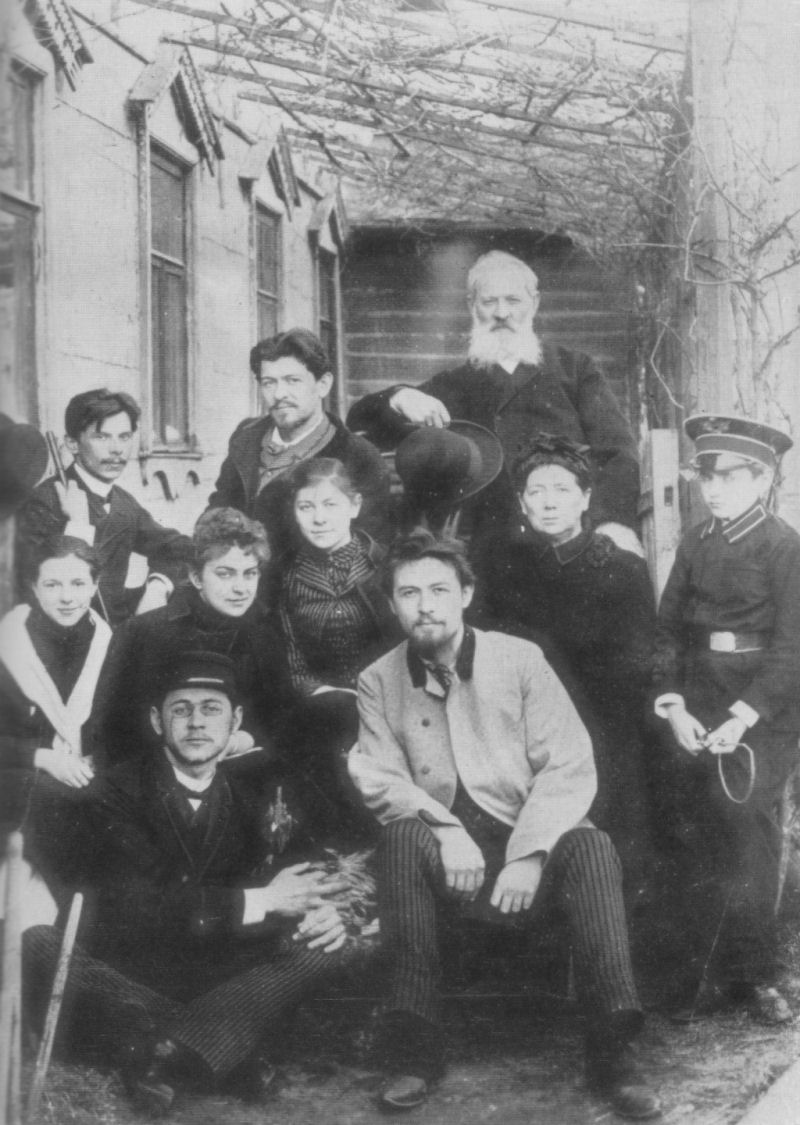
Chekhov and  family